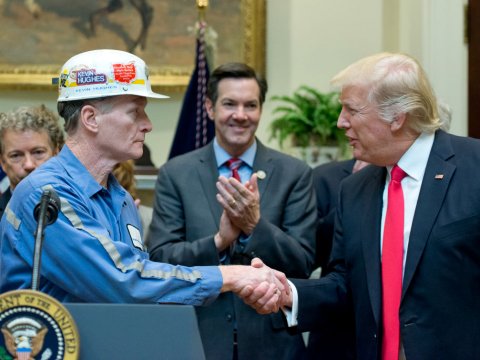
One of Trump’s many claims has been that the tariffs will help bring manufacturing jobs back to the United States. With the steel tariffs being delivered on the question then becomes, will steel manufacturing jobs come back to the United States?
There is a perception that the United States has lost its manufacturing sector. Every election cycle politicians bring out sad looking blue collar workers to lament the decline of American manufacturing. These commercials fundamentally tug at the heartstrings of Americana itself. America prides itself as the unparalleled leader in hard work, productivity, and making things right.

The reality is that American manufacturing output is stronger than ever. Instead it is the decline in jobs and payroll that leads to the perception of declining American manufacturing prestige. Automation has been the biggest factor in declining manufacturing jobs, as machines replace humans.
But let us say that Trump’s tariffs will somehow miraculously lead to at least the contemplation of bringing more manufacturing jobs back to the United States. This will necessitate a few things:
- Demand from consumers.
- Investments from large corporations.
- Companies considering the long term over quarterly profits (i.e. shareholders reconsidering priorities).
- Economic stability.
- A willingness to invest 5+ years down the road, when the political whims of the executive branch and congress may change.
Firstly, there will have to be demand from consumers. Trade wars hit the lower and middle classes far more than the upper class. If the lower and middle class are hit with lost wages or jobs then there will be less demand. So right off the bat there is a potential problem. But let us assume that this is not the case, for the sake of argument.
Second, there would have to be investments from large corporations capable of funding or expanding large facilities. This takes a long time, with capital expense requests needing to be submitted, reviewed, approved, and then real plans being crafted. Here’s how it works:
- A company sees there is a potential for sustainable profitability. They decide to open a new facility. To simplify matters, they opt to bring an old one up to speed.
- A plan must be drafted with thorough analysis to justify this expense, as it will be a large one.
- Lawyers and other higher ups must then negotiate, draft, sign off on, and approve the purchase of the property.
- The company must then secure machinery, allocate time and resources to bring a facility up to code, and then begin recruiting for the plant.
- The plant must then be fully staffed and go through its growing pains of refining its operation to a level of acceptable productivity. Plants will operate at a loss for a period of months, normally years, before becoming truly profitable and offering a return.
To justify step #2, we get to step #3 – economic stability. There must be enough of a guarantee that the circumstances will not change to allow a company to justify such an investment. The more likely course of action is that existing companies would simply expand their operations to handle additional volume, as this is generally easier to scale. But this would also mean that companies would be looking to make next generation advancements.
That means that companies would be seeking to produce more and cost themselves less. That means more automation. There is actually the potential for jobs to be lost as corporate profits increase. Which gets back to the root of the issue that caused all of this in the first place – jobs are being lost to automation more than they are foreign competition.
Is offshoring jobs a serious problem for American workers? Yes. But is it the only problem? No. And is it the biggest problem? Absolutely not.
As the economy continues to evolve we face a future where we risk greater economic instability as jobs erode. There is a reason that Universal Basic Income, or UBI, is being seriously debated, when just ten years ago it would’ve been viewed as a joke. After all, if everything is automated and barely anyone is needed to fill the jobs, who will have money for goods and services?
Manufacturing has become automated. Fast food chains are looking to automate ordering. Uber and Lyft are working on automated cars (taxi services). Algorithms are being developed to help you troubleshoot problems. Computers are being used for surgeries. The AI future is near.
And as fickle as Congress and the President are, will companies take them seriously? Politics changes, and it changes quickly. If you can’t rely on something in business then you consider it an undesirable factor in your equations. Companies are banking on returns 5-10 years down the line, while simultaneously being beholden to quarterly profitability demands of their shareholders. So they would be more inclined to break investments down over several quarters, or even years, than they would in the immediate future. And they certainly will not rely on Congress or the President for guarantees.
The bottom line is American manufacturing is doing just fine. American jobs are not, and the tariffs are unlikely to result in any fundamental changes to how we got here. The future holds many things, but the days of the blue collar worker making a widget for what amounted to $30 / hour with pensions after inflation is long gone.
 The Rushin Perspective
Leave a comment