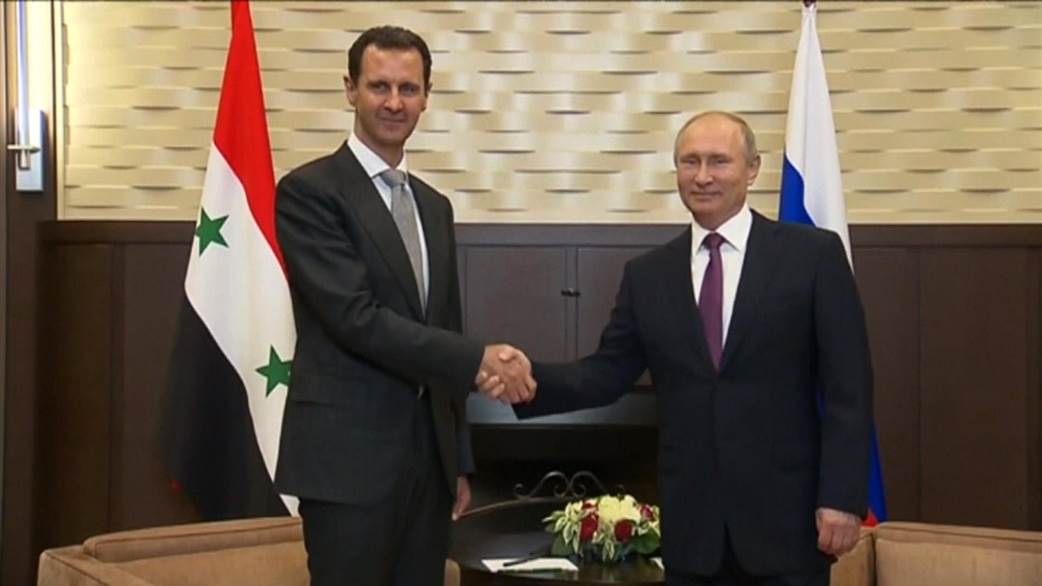
Most people know that Russia backs Syria and the United States backs not-Syria. This has been standard operating procedure ever since the end of World War II – if the United States liked or backed something, Russia backed the opposite. While much of this can be chalked up to Cold War era bickering and geopolitics, there is a sound historical basis for Russia’s choosing to back Bashar al-Assad.
The United States is a comparatively very young nation, having never fought a true defensive war on its home turf since becoming the nation as we know it today. Russia, on the other hand, has a very colorful past, full of brutal invasions and threats to its very survival. Many of these threats metastasized into reality, with tens of millions of Russians dying. The most recent example, the Nazi invasion of Russia, cost Russia fifty times as many casualties as the United States suffered in World War II. This would have a long lasting impact on the psyche of any nation.
Russia’s primary defensive weapon historically has been land. Land to buy time during an invasion. Land to bog the enemy down. Land to provide a home field advantage. Land for resources. The Russians even have a name for their ploy of using their land to their advantage – ‘General Winter’.
So how does this factor into Syria?
During the Cold War the Russians were obsessed with creating and sustaining satellite states to insulate Russia itself from any future invasions. The more territory they conquered, whether directly or indirectly, the more land they would have to protect the motherland from future incursions. This was both a strategy predicated on historical reality, as well as a psycho-cultural issue for Russians.
Following a series of coups that led to the eventual rise of Bashar al-Assad’s father, Hafez al-Assad, in 1971, the then-Soviet Union managed to negotiate for a naval base at Tartus in Syria. This is the only remaining Russian base outside of Soviet era territory, and is a key point of power projection throughout both the Middle East and Mediterranean. Thus Tartus is a point of both pride as well as practicality.
By maintaining the ability to project military power in NATO’s neck of the woods the Russians theorize – rightfully – that they can distract the west from both Russia’s interior, as well as other territorial ploys, e.g. Crimea.
The Syrian regime, acting effectively as a client state, has had the unintended consequence of allowing Russia to utilize much the same rationale that the George W. Bush administration used in justifying its war in Iraq. That is, “better to fight them there than here”. Russia has faced two brutal civil wars in its Chechnya region. Chechen fighters have poured into Iraq and Syria, and facing them in Syria is preferable for Russian internal security and stability than fighting them domestically. It is easy to forget that Russia has faced terror attacks that have surpassed in many ways the brutality of attacks the United States has endured.
Vladimir Putin is a product of the Soviet KGB, and he has a cold calculus that can rationalize much, so long as it benefits Russia. Ignoring a few chemical attacks or atrocities is easy when the payoff is maintaining a semblance of global power projection, allaying Russian psychological fears of a lack of territory to protect themselves from invasion, and providing Chechen extremists with a battlefield in a far off land.
 The Rushin Perspective
Leave a comment